
|
Image Stabilization in Olympus E-3 A Quantitative Evaluation |
|
|
My other articles related to the |
|
The new Olympus flagship SLR, the E-3, like the preceding E-510, has a body-based image stabilization system, as briefly described in my I have learned never to take similar claims at the face value, especially if they are not supported by any hard data and/or references to method used. This is why I had to make an attempt to check these. As the whole image blur process is of stochastic nature (after all, how your hands shake is not a very repeatable process), I had to devise a method which would be reproducible in the aspects which could be made such, and statistically sound in others. I think my method holds water in both these areas. Experiment design and result interpretation
A detailed description of the procedures used, including statistical processing of raw results, can be found in a | That article, while requiring some effort to read, is a highly recommended introduction to this report, necessary to understand my results.
|  | |
 Subjective "bad" |
 Subjective "medium" |
 Subjective "good" |
|
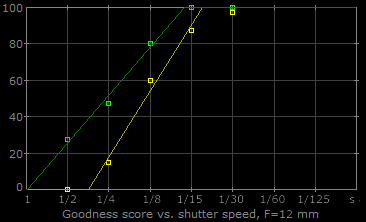
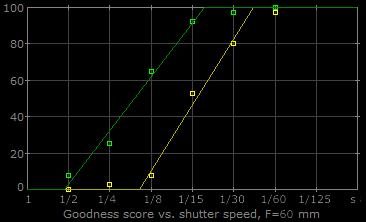
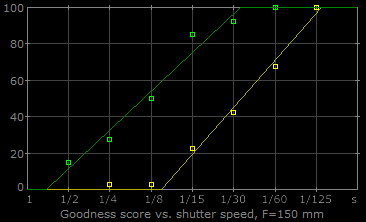
Now, time for the moment of truth. All raw and semi-processed numbers are, again, in the Appendices; here I'm showing only the data points and best-fit lines describing the behavior of success rate versus shutter speed. Remember: for each focal length the value of Δv50, or the horizontal spacing between lines at half-height, is the measure of the gain we are getting from image stabilization. I've performed the experiment for three different focal lengths. For 12 and 60 mm I've been using the 12-60 mm F/2.8-4.0 ZD lens (quite large and heavy); for 150 mm — the tiny and light 40-150 mm F/4.0-5.6 ZD.
| 12 mm: The improvement, Δv50, is about 0.95 EV (shutter speed factor of 1.9×). For the E-510 I've got 1.05 EV (2.1×) with the 14-42 mm ZD at 14 mm. As my guesstimate of the statistical error in this parameter is 0.2 EV (maybe slightly more?), I consider both results practically identical. (Interestingly, the lines are no longer so nicely parallel as before. Possibly a heavier camera, or a heavier lens? Or maybe something in my experiment?)
| 
| 60 mm: The improvement in v50 for this focal length is 1.5 EV (2.8×). This is close, again, to 1.6 EV (3.0×) I've got for the E-510 with the 14-42 mm ZD at 42 mm; even the lines run in a very similar manner.
| 
| 150 mm: Here v50 improves by 2.4 EV (shutter speeds 5.2× longer). The same 40-150 mm "new kit" zoom was used with the E-510 to arrive to a value of 2.2 EV (4.7×). The difference may be statistically significant, but for all practical purposes IS in both cameras is bringing the same benefit.
| 
| Conclusions The results of my small experiment may be summarized as follows:
It is possible (I would say: thinkable) that under more adverse conditions, when handholdable shutter speeds are higher (less steady hands, longer lenses), the improvement may be more visible. This is hinted by the results for different focal lengths, obtained for both cameras I've tried. I have, however, no hard data to support or dispute such a hypothesis. It would be interesting to repeat the experiment for the 70-300 mm ZD lens (which I did not have at the time). Last but not least, a comparison of v50 for both cameras at similar focal lengths shows that not only the improvement, but also handholdability threshold itself is the same for both cameras in spite of differences in weight and size of the lens/camera combinations. These are the raw "bad-medium-good" frame counts for each series of frames, with the success rate (percent) shown below, as described in the E-510 IS article. | ||
| IS OFF | 1/2" | 1/4" | 1/8" | 1/15" | 1/30" | 1/60" | 1/125" |
|---|---|---|---|---|---|---|---|
| 12 mm | 20-0-0 R = 0 | 16-2-2 R = 15 | 5-6-9 R = 60 | 0-5-15 R = 87.5 | 0-1-19 R = 97.5 | - | - |
| 60 mm | 20-0-0 R = 0 | 19-1-0 R = 2.5 | 17-3-0 R = 7.5 | 8-3-9 R = 52.5 | 0-8-12 R = 80 | 0-1-19 R = 97.5 | - |
| 150 mm | - | 19-1-0 R = 2.5 | 19-1-0 R = 2.5 | 13-5-2 R = 22.5 | 7-9-4 R = 42.5 | 1-11-8 R = 67.5 | 0-0-20 R = 100 |
| IS ON | 1/2" | 1/4" | 1/8" | 1/15" | 1/30" | 1/60" | 1/125" |
| 12 mm | 13-3-4 R = 27.5 | 4-13-3 R = 47.5 | 3-2-15 R = 80 | 0-0-20 R = 100 | 0-0-20 R = 100 | - | - |
| 60 mm | 17-3-0 R = 7.5 | 14-2-4 R = 25 | 5-4-11 R = 65 | 1-1-18 R = 92.5 | 0-1-19 R = 97.5 | 0-0-20 R = 100 | - |
| 150 mm | 16-2-2 R = 15 | 13-3-4 R = 22.5 | 7-6-7 R = 50 | 0-6-14 R = 85 | 0-3-17 R = 92.5 | 0-0-20 R = 100 | 0-0-20 R = 100 |
|
Appendix Two: The v coefficients More interesting: the values of v0 and v100, as described in the other article. |
| IS OFF | IS ON | Δv50 | |||||
|---|---|---|---|---|---|---|---|
| v0 | v100 | v50 | v0 | v100 | v50 | ||
| 12 mm | 1.506 1/2.8" | 4.264 1/19" | 2.885 1/7.4" | 0.032 1/1.0" | 3.841 1/14" | 1.937 1/3.8" | 0.948 1.93× |
| 60 mm | 2.713 1/6.6" | 5.471 1/44" | 4.092 1/17" | 0.890 1/1.9" | 4.280 1/19" | 2.585 1/6.0" | 1.507 2.85× |
| 150 mm | 3.243 1/9.5 | 7.126 1/140 | 5.184 1/36" | 0.459 1/1.4" | 5.165 1/36" | 2.812 1/7.0" | 2.372 5.18× |
|
|
My other articles related to the |
|
Olympus® is a registered trademark of Olympus Corporation.
This page is not sponsored or endorsed by Olympus (or anyone else) and presents solely the views of the author. |
| Home: wrotniak.net | Search this site | Change font size |
| Posted 2008/02/15, last updated 2013/12/15 | Copyright © 2008-2013 by J. Andrzej Wrotniak |